Aircraft / 2024
Insomnio
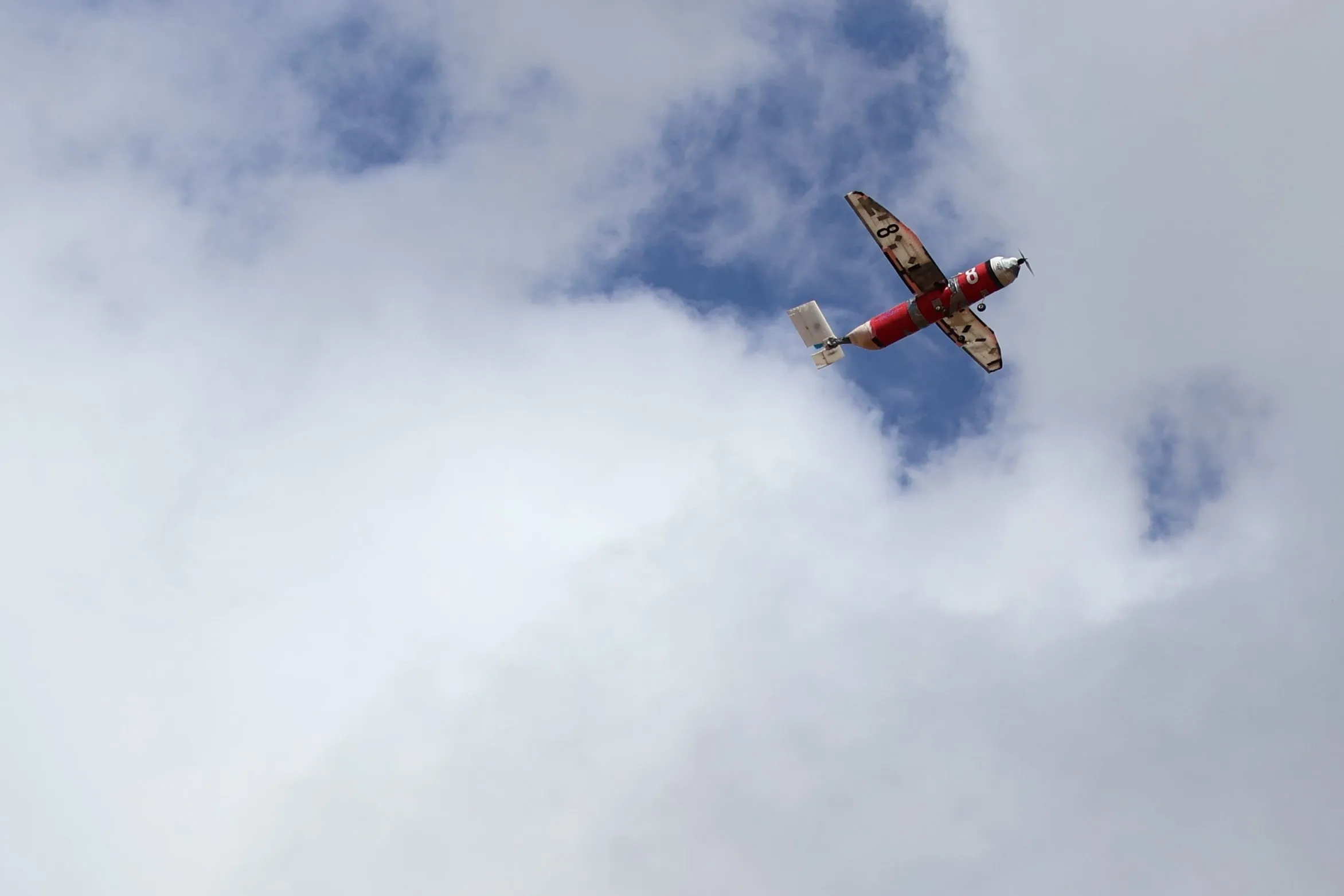
DIANA's first aircraft, almost entirely 3D-printed in LW-PLA. It flew at the XtraChallenge 2024 carrying more than 200 ping-pong balls.
- Aircraft
- Insomnio
- Season
- 2023/24
- Competition
- XtraChallenge 2024
- Result
- Award for the heaviest payload
- Sheet
- 1 / 3
Technical data
Geometry
| Wingspan | 2,201 mm |
|---|---|
| Length | 1,518 mm |
| Wing area | 0.449 m² |
| Taper ratio | 0.25 |
| Mean aerodynamic chord | 218 mm |
| Planform | Swept wing |
| Wing aerofoil | ED216Chosen over the AG17 and AG19 for efficiency and a gentler stall |
| Tail | V-tail |
| Tail aerofoil | NACA 0012 |
| Control surfaces | Flaperons (aileron and flap in the same surface) |
Masses
| Empty mass | 1.325 kg |
|---|---|
| Maximum design payload | 2.175 kg |
| Maximum take-off mass | 3.5 kg |
| Payload at the competition | More than 200 ping-pong balls and a billiard ball |
Performance
| Cruise speed | 15 m/s |
|---|---|
| Take-off distance | 15 m, theoretical at maximum mass |
| Coefficients | CL0 = 0.6 · CD0 = 0.02 · CL/CD = 80 at 7° |
Propulsion
| Motor | Emax GT2820 985KV |
|---|---|
| Propeller | Aero-naut CAM Carbon Light 10x7 |
| Power battery | Tattu FunFly 3S, 1,300 mAh, 100C |
Avionics
| Transmitter and receiver | Turnigy 9X, 9 channels |
|---|---|
| Flight controller | None |
| Telemetry | None |
| Servos | MG90S |
| Receiver battery | Gens Ace 2S, 800 mAh |
| 5 V supply | UBEC |
Structure and manufacturing
| Method | About 90 % 3D-printed in LW-PLA |
|---|---|
| Wings | Skin and internal structure printed as a single part, in four sections under 30 cm |
| Wing reinforcement | Aluminium tube reinforced with a solid steel bar |
| Tail assembly | Aluminium tube |
| Landing gear | Steel bar, made in-house |
| Prototype cost | €317.82 (about €120 of materials and €198 of electronics) |
| Test bench | In-house, with a strain gauge, current and voltage sensor and laser RPM sensor, run by an Arduino |
How it was made
Design
The strategy was to score as high as possible in the light payload task, and that meant maximising the payload volume. The internal structure of the fuselage got in the way, so it was merged with the payload: the inner diameter and the shape of the fuselage were optimised to fit as many balls as possible. The V-tail was chosen for efficiency, and the wings were 3D-printed.
Construction
Almost the whole aircraft was printed in LW-PLA. The wings and the tail were printed in continuous layers and the fuselage was a thin-walled cylinder. Each wing was split into four sections under 30 cm long, from root to tip, printed vertically. Each print took between 8 and 10 hours, and LW-PLA is delicate: many parts failed and had to be printed again. The aircraft was designed so that every part could be printed.
There were two design iterations. The second one went to the competition.
What went wrong and how it was fixed
Wing reinforcement. The aluminium spars could not take the weight of the aircraft. They were reinforced with hollow steel bars at the joints.
Landing gear. It was not straight. It was given dihedral, like full-size landing gear, and bent just enough for the aircraft to roll straight.
V-tail angle. It was too flat: it left little vertical surface and the aircraft lost stability on every axis. The angle between the two surfaces was closed up.
Battery. The one chosen did not last a full flight and caused a crash.
Centre of gravity with payload. The measurement was wrong and left the aircraft unstable. It was balanced by adding weight in the nose.
Payload hatch. The fuselage opening for loading the payload was badly designed. It was fixed with tape.
Aileron travel. The maximum programmed deflection was too small to correct the aircraft on take-off and in flight. A larger one was programmed.
In Valencia
Insomnio finished last in the overall ranking of the XtraChallenge 2024, but took the award for the heaviest payload, with more than 200 ping-pong balls and a billiard ball inside. In the team’s words: “Two more weeks and it would have been a different story”.